Biological control
Silent SpringBiological control is the use of living organisms and their ecological relationships to limit a pest or unwanted plant. In the examples developed in the book, it offers a counterpoint to indiscriminate spraying: instead of killing broadly across a landscape, a carefully matched organism acts on a narrower target, and the resulting reduction can make room for other species to return. Its significance lies not simply in replacing one control agent with another, but in treating the target as part of a living community whose balance and dependencies matter.
An ecological alternative to eradication
The book frames biological control against campaigns that define a landscape chiefly as a problem to be cleared. The western sage country, formed over millions of years by the uplift of the Rocky Mountain system, is described as a land of harsh climatic extremes, where plants and animals developed in relation to its conditions. Sagebrush, pronghorn antelope, and grouse belong to that evolved arrangement. Yet land-management agencies, responding to cattlemen’s demand for more grazing, sought grassland without sage. Spraying aimed at the unwanted vegetation could therefore alter more than the intended plant: it imposed a simplified purpose on a habitat shaped by many interacting forms of life.
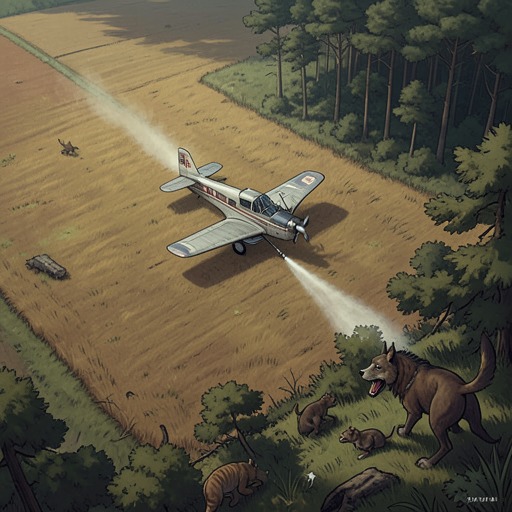
The consequences of that broad approach are illustrated by the United States Forest Service’s spraying of about 10,000 acres of sage country in Bridger National Forest, Wyoming. The spray killed willows as well as sagebrush. When William O. Douglas visited in 1959, the year of the spraying, he saw the willows shriveled and dying; the loss extended beyond vegetation, because beavers depended on the willows, and the region had offered fishing and hunting. The episode makes the contrast with biological control concrete: the distinction is between treating a place as a single unwanted growth to be eliminated and recognizing that a targeted intervention can reverberate through habitat and human uses of it.
The Klamath weed example
The book’s clearest account of biological control concerns Klamath weed, also known as St. Johnswort. In the western range, its spread was associated with serious losses: livestock that fed on the toxic plant became scabby, sore-mouthed, and unthrifty, and land values fell. The plant was considered to hold the first mortgage on affected land. In Europe, however, Klamath weed had not become the same kind of problem. Insects that had developed alongside it fed on the plant and limited its abundance.
Two beetle species in southern France were especially adapted to the weed. Pea-sized and metallic in colour, they fed and reproduced only on it. Their narrow dependence made them useful precisely because they were not general agents of destruction: their feeding was concentrated on the plant that control efforts sought to reduce. In 1944, the first shipments of these beetles arrived in the United States. The book identifies this as the first North American attempt to control a plant with a plant-eating insect, marking a new application of biological control rather than a conventional chemical assault.
By 1948 both beetle species had become so well established that no further importations were necessary. They dispersed on their own, moving away as Klamath weed died out and locating new stands with precision. Their spread was thus linked to the distribution of their food source. As the beetles thinned the weed, desirable range plants that had been crowded out could return. The intervention did not seek to sterilize the landscape or replace it with a single preferred crop; its reported consequence was the recovery of vegetation previously suppressed by the target plant.
A ten-year survey completed in 1959 found that control had been more effective than even its enthusiasts had hoped: Klamath weed had fallen to one per cent of its former abundance. The remaining trace infestation was described as harmless. The result is significant both for its scale and for its qualification. Success did not mean that the organism had been made absolutely absent; it meant that its abundance had been reduced to a level no longer considered damaging, while the beetles could move on and other range plants regain space.
Specificity and ecological relationships
The Japanese beetle account extends the principle from plant control to insect pests. After the beetle spread beyond its native range, it increased rapidly, freed from restraints that had kept it in check at home. By 1945, however, it had become a pest of only minor importance through much of the territory it had invaded. The book attributes much of this decline to imported parasitic insects and established disease organisms fatal to the beetle, describing natural control as a result of studying and reintroducing relationships from the pest’s native range.
Between 1920 and 1933, efforts to establish such control involved searching throughout the beetle’s native range. Five imported natural enemies became established in the eastern United States. Among them, the parasitic wasp Tiphia vernalis was the most effective and widely distributed. The female wasp finds a beetle grub in the soil, injects it with a paralyzing fluid, and attaches a single egg to the grub’s underside. After hatching, the wasp larva feeds on the immobilized grub and destroys it. The life cycle supplies the control mechanism: the wasp’s attack is directed at a particular host stage, rather than at every organism sharing the soil.
Colonies of Tiphia were introduced into 14 eastern states over roughly 25 years through a cooperative program involving state and federal agencies. The wasp became widely established, and entomologists generally credited it with an important role in bringing the beetle under control. The account presents this as a cumulative undertaking: searching, introduction, establishment, and eventual assessment, rather than a single act of extermination.
An even more important role, the book says, was played by a bacterial disease affecting beetles in the scarabaeid family, to which the Japanese beetle belongs. The organism was highly specific: it attacked no other type of insect and was harmless to earthworms, warm-blooded animals, and plants. That selectivity distinguishes biological control from the broad-spectrum poisoning described elsewhere in the book. The value of an agent is measured not only by whether it harms the target, but also by what it leaves unharmed.
Evidence, limits, and significance
Biological control appears in the book as an alternative grounded in ecological knowledge, not as a universal shortcut. The author argues that vegetation programs should aim to manage plant life as a community rather than destroy a particular species indiscriminately. The Klamath weed beetles demonstrate how control can be tied to a target’s natural enemies and to the return of desirable plants; the Japanese beetle example shows that parasitism and disease can likewise constrain an insect pest. Both cases depend on relationships that already exist in nature, or that can be established through deliberate study.
The contrast matters because the book repeatedly associates chemical campaigns with collateral damage, including the loss of non-target vegetation, wildlife, and public confidence. In its account of the fire ant program, for example, studies by state and federal wildlife biologists and several universities found losses ranging up to the complete destruction of wildlife in some treated areas; poultry, livestock, and pets were also killed. Woodcock wintering in Louisiana carried residues of fire-ant poisons, with the contamination traced through their feeding on earthworms. These consequences sharpen the practical question behind biological control: whether a program can limit the organism it is meant to control without spreading harm through the wider web of life.
The book’s case for biological control rests on outcomes that are specific and observable: the beetles’ establishment, their movement between stands of Klamath weed, the recovery of crowded-out range plants, the 1959 survey’s one-per-cent figure, and the Japanese beetle’s decline alongside introduced enemies. Together, these examples make biological control a model of intervention that works with ecological relations rather than treating them as obstacles. Its promise is not the fantasy of a landscape without troublesome species, but the possibility of limiting damage while preserving the living system on which both wildlife and human use depend.